Showing posts with label William Roy I b1811. Show all posts

Wednesday, 10 August 2022

Life on Prieston Road


The previous post traced William and Margaret's marriage and the births of their six children. In this post, we look at where they lived as a family and how William supported them.

William Roy I - lease in perpetuity

In 1848, we can find William I as the proprietor of a house in Prieston Road in Bankfoot via the Perthshire Cess Roll for Auchtergaven in 1848.1 Cess, stent and valuation rolls were variously used to record property details, valuations, rental values and tax. The 1848 roll shows the proprietor and the tenant of each property, describes the property and gives an annual rental value. In the entry for a house on Prieston Road, William Roy is shown as being the proprietor, as well as the tenant. The value is £3 with deductions of six shillings, leading to a net value of £2 14/-. 

In later years' Rolls, the same group of houses are described as 'Feus of Bankfoot'. Feu is a word from Scots law which describes a perpetual lease at a fixed rent. Traditionally in Scotland the feu was the 'most common form of land tenure.' The property was held in perpetuity in return for an annual fee (feu) paid to the landowner - often a noble person or large landowner, who then had a similar obligation up the line, ultimately to the monarch.2

A letter writer to The Courier in 2015 described how James Wylie, who was given the Airleywright Estate in Auchtergaven in 1806 by his mother Grizel Wylie, was an 'agricultural improver' who set about consolidating the many small landholdings on his estate into a large farm structure. Obviously to do so displaced the people who had traditionally lived on and farmed those small pieces of land - so he created feus in the villages of Bankfoot and Waterloo and offered them 'to the dispossessed'.3 

As 'proprietor' of one of those houses, William would have entered into a Feu Charter agreement and paid the annual fee to James's son Thomas Wylie. 

Prieston Road on the Bankfoot map

The map of Bankfoot below (from 1867) shows the outlines of the houses along Prieston Road (inside the blue oval), Airleywright House (orange circle) and the proximity of the parish school and the church (arrows).4 Each of the houses has its own piece of land behind. 

The main road between Perth and Dunkeld is the road the runs northwest from the orange arrow (Dunkeld Road) and that is also where the Bankfoot Inn, Diamond Inn and Athole Tavern and police station were found. This is also the road that Queen Victoria passed along in 1842 as she made her first journey to Scotland. 

Newspaper and contemporary accounts of her trip describe how the road between Perth and Dunkeld was lined with thousands of people, arches had been erected at various points, and houses were bedecked with flowers. We can imagine that  the newly married William and Margaret could have been alongside that road to see Victoria...it wasn't everyday that the monarch passed by!

Later on, the Airleywright linen works would be located near the intersection of Prieston and Dunkeld Roads. 

(If you click on the map, it will open onto a larger screen where it is easier to see the detail.)

Image reproduced with the permission of the National Library of Scotland

When I visited Bankfoot in 2019, without any street numbering as a reference, I walked along Prieston Road, trying 'to get a feel' for where William and Margaret may have lived. The village is small, even today, and it is just a short walk between the main locations.  

Prieston Road, Bankfoot, August 2019. Photo by Alison Dennison

By using the Streetview feature of Google Maps, you can do the same:


The Roys in the 1851 Census

As we found out in the previous post, by 1851 William and Margaret had five children who they would have raised in their house in Prieston Road. However, when I checked the 1851 Census for Bankfoot, I could only find Margaret and four children in the household and the address is '6 Laganally Street' (which runs perpendicular to Prieston Road, and is now called Newhall Street):

Head of household is Margaret Roy (aged 37), married, born in Little Dunkeld. Also living the same household are:

  • James Roy, son, aged 8, scholar, born in Auchtergaven
  • John Roy, son, aged 7, scholar, born in Auchtergaven
  • William Roy, son, aged 5, born in Auchtergaven
  • George Roy, son, aged 1, born in Auchtergaven 5
Susan, who was born in 1848 is not in the household, leading me to believe that she died as an infant, as I have not been able to find any trace of her elsewhere in the 1851 census, nor in later censuses. A fifth son, Donald is not yet born (b. 1853). The older two children attended school (as indicated by 'scholar') which could have been the parish school you can see on the map above - although there were three schools in Bankfoot at that time. 

But where is William Roy I? (Note that Margaret's census entry says 'married', not 'widowed', so I was pretty sure he was still alive.)

For several years I was unable to find William in 1851 despite lots of creative searching...then, suddenly I spotted a 38 year old William Roy, born in Auchtergaven in the census of Balquidder, which was still in Perthshire, but about 50 miles from Bankfoot.

William was listed in that census at 'Craigruie' in Balquidder, a member of a party of 34 made up of construction workers (and a cook) employed by John Borrie, contractor of drainage from Dunkeld. Among the list of names of workers were several who were born in Auchtergaven. In the enumerators' notes at the beginning of that census volume, he notes that on the night of the census (March 30, 1851) there were a number of temporary residents working on two projects, one of which was the construction of drainage at Craigruie.6 

Was William no longer working as a miller? Or was this an 'off-season' job for some extra income? Milling the grain was a slow process in the 19th century, with the grain harvest milled year-round, so you would expect a miller to be in full-time employment. The fact that William is working on a construction crew as a labourer in March 1851, suggests to me that he was no longer employed as a miller. But maybe it was just a quick job and the census just happened to catch him there? Following this up is one of my future research tasks!

The short life of Donald Roy (1853-1859)


In August 1853, the youngest of William and Margaret's children was born, a son called Donald. However his life was to be a short one, as he died at their Prieston Road home on 27 September 1859, aged six years, from 'scarlatina maligna' - an extreme form of scarlet fever. He had the disease for 3 days and was buried in the churchyard at Bankfoot.7

William Roy I was the informant on Donald's death certificate, and he gives his occupation as 'field labourer', which would indicate that he was no longer working as a miller. Indeed, at the time of the 1861 census, he reports his occupation as agricultural labourer (Ag Lab).8

The 1861 Census


On the night of 7 April 1861, only William Roy I, Margaret and William Roy II were at the house on Prieston Road. James and John were working elsewhere, and I have not been able to locate George so far (although I know he was still alive). William, aged 49, is the reported head of the household which also included:
  • Margaret Roy, aged 47
  • William Roy, aged 14, Farm Servant
The house is reported to have three rooms with one or more windows.8 

The 1871 Census

Ten years later, in 1871, William, aged 58,  is reportedly back to being a 'meal miller'. They're still in Prieston Road, but the house is now reported to only have two rooms with one or more windows. Included in the household are:

  • Margaret Roy, aged 56, meal miller's wife
  • George Roy, aged 21, unmarried, joiner
  • Margaret Roy, aged 1, granddaughter, born in Auchtergaven.9

Young Margaret Roy is a bit of a mystery, as there are only two Margaret Roys born in Perthshire between 1869-1871 and neither of them seem likely matches. This is one to keep working on! 

So where are the other siblings - James, John and William Roy II at the time of the 1871 census? 

  • James has not been found in the 1871 census but is possibly living at Logierait, as he was a ploughman there in the 1861 Census and then married there in 1882.
  • John is married, with four children and living at 43 Rosebank St in Dundee where he is working as a railway company carter.11 (see the Dundee branch details on The Family Tree page)
  • William Roy II is a lodger at 11 Market Street in the Carlton district of Glasgow and is working as a carter.12 
Just over a year later, Glasgow will play a much more significant role in William Roy I and Margaret's lives...but that's a story for the next post. 

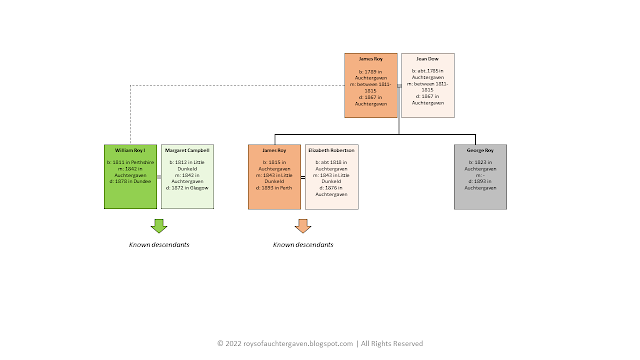
Confused about where these characters fit into the family tree? Or where this action is occurring?  You can always check The Family Tree and Map pages for visual clues.

Footnotes

  1. Perth and Kinross Council Archive; Cess Rolls Perthshire, 1848-1848; Roll: SCPERa018_029Cs18481848, 1848.
  2. Designing Buildings, 'Feu charter' Designing Buildings - The Construction Wiki website, 1 Dec 2020, https://www.designingbuildings.co.uk/wiki/Feu_charter, accessed 10 August 2022
  3. Michael Lawrence, 'Letters to the Editor: The facts about Airleywright', The Courier (Scotland), 9 Jun 2015, p26
  4. Ordnance Survey Map, Six-ince 1st edition, 1843-1882, Perthshire, Sheet LXXIII, Surveyed: 1864, Published: 1867, National Library of Scotland, https://maps.nls.uk/ 
  5. Census record for Margaret Roy, aged 37, Bankfoot, Auchtergaven, Scotland, 1851 Scotland Census, National Records of Scotland, scotlandspeople.gov.uk.
  6. Census record for William Roy, aged 38, Balquhidder, Perthshire, Scotland, 1851 Scotland Census, National Records of Scotland, scotlandspeople.gov.uk.
  7. Baptism of Donald Roy, born 5 Aug 1853, Old Parish Registers Births, 330/20 p.270
  8. Death registration of Donald Roy, died 27 Sep 1853, Statutory registers - Deaths, National Records of Scotland, 330/ 36, scotlandspeople.gov.uk
  9. Census record for William Roy, aged 49, Bankfoot, Auchtergaven, Scotland, 1861 Scotland Census, National Records of Scotland, scotlandspeople.gov.uk
  10. Census record for William Roy, aged 58, Bankfoot, Auchtergaven, Scotland, 1871 Scotland Census, National Records of Scotland, scotlandspeople.gov.uk
  11. Census record for John Roy, aged 27, Dundee, Scotland, 1871 Census, National Records of Scotland, scotlandspeople.gov.uk
  12. Census record for William Roy, aged 25, Calton, Glasgow, Scotland, 1871 Census, National Records of Scotland, scotlandspeople.gov.uk

Sunday, 12 June 2022

William I and Margaret start a life together


In the previous two posts, we looked at William Roy I's first 30 years and the same for Margaret Campbell. So now we need to bring the two of them together!

As discussed in the previous posts, it is possible that William and Margaret knew each other as children, as William's maternal grandparents, the Peddies lived at Ballinloan in Little Dunkeld, while Margaret and her Campbell siblings grew up at Meikle Logie, less than a mile (1.5 kms) away. The nearest church for both hamlets was the tiny church of Laganallachy, which we have previously viewed in Google Streetview format. Services were conducted there once a month in Gaelic, and for the remaining weeks, the families would have walked to the Parish Church in Little Dunkeld. We can't be sure that William and Margaret met at this point, but we do know for certain that they had met by March 1842, when they married!

On the census night of 6 June 1841, Margaret was living with her widowed mother and youngest brother at Meikle Logie, and William was a miller at Balmacolly near Bankfoot.1  Nine months later, on Friday 4 March 1842, they married in the parish of Auchtergaven, having 'given in their names in order to proclamation of banns' on 19 February (two weeks earlier).2  

Auchtergaven Church ruins and churchyard in Bankfoot by Alison Dennison (2019)


In the parish register William is listed as 'residing at Balmacolly', and Margaret is described as 'residing at Bankfoot', which suggests that she had moved there from Meikle Logie - perhaps in anticipation of their marriage, or to work, or to live with her brother John (who died at Bankfoot in 1853, according to the inscription on the gravestone in Laganallachy graveyard).3

Their first child, James was born on 4 December 1842, almost exactly nine months (or 39 weeks) after the marriage.4 The parish register shows that William was still a miller at that point, and resided in Bankfoot. James was baptised on 18 December 1842.

The next child was also a son, John, and he was born almost two years later on 26 February 1844 (baptised 13 March 1844), followed by William Roy II another two years after that on 8 April 1846 (baptised 19 April 1846), the only daughter, Susan born 22 April 1848 (baptised 7 May 1848), George born 8 December 1849 and Donald born 5 August 1853.5


While there is a birth interval of approximately two years between the first four children, George followed only 1 year and 7 months after Susan, who is missing from the household by the time of the 1851 census. This could suggest that she died within the first year of her life. There is no record of her burial in the Auchtergaven Graveyard inscriptions.

Interestingly, despite being almost four years apart in age, George and Donald's births are registered one after each other on the same page of the parish register. The rest of the births on that page and the previous three pages of the register are a jumbled assortment ranging from 1840 to 1854, which would suggest that the church had done a bit of a tidy up of missing baptisms in the records, and captured them all in one fell swoop.  

The Minister of the Auchtergaven throughout some of those years was Reverend Thomas Nelson, who had been ordained in 1831 and died on 27 March 1852.6  The parish minutes of 1852 note his passing, and say that 'Mr Nelson has been for nearly two years unable to discharge his public duties', and that he had 'several attacks of palsy' before one final one.7 He was replaced by the Assistant Minister, Reverend Edward Place Dewar, who was a youngster of around 25 years of age and died himself just three years later while in Cairo, Egypt in November 1855.8 Perhaps paperwork was not either of the Reverends' thing? 

The introduction of statutory registration in Scotland for births from 1 January 1855 may have caused the incoming Minister, Reverend David Landall to tidy up the existing baptism registers and attempt to capture any recent missing details.9 The register pages I viewed contain many entries for families with multiple children listed immediately after each other, such as in George and Donald's case, which would certainly suggest that there was an attempt to capture each family's missing baptisms. 

On each of the registers of his children's births/baptisms, William Roy I is described as 'miller' which suggests that he maintained that occupation until at the time that these births/baptisms were recorded. He must have done alright for himself for a time as, by 1848, he was listed as 'proprietor' of the home in which the family was living on Prieston Road in Bankfoot rather than 'tenant'.10 However, as we'll find out in the next post, he appears to have lost employment as a miller around the 1850s, early 1860s. 

We'll follow up on William's employment history in the next installment, which will take up the story around the point of the 1851 Census.


Confused about where these characters fit into the family tree? Or where this action is occurring?  You can always check The Family Tree and Map pages for visual clues.


Footnotes
  1. Census record for William Roy, aged 30, Colly, Auchtergaven, Scotland, 1841 Scotland Census, National Records of Scotland, scotlandspeople.gov.uk.; Census record for Margaret Campbell, aged 25, Meikle Logie, Little Dunkeld Scotland, 1841 Scotland Census, National Records of Scotland, scotlandspeople.gov.uk.
  2. Marriage of William Roy and Margaret Campbell, married 4 March 1842, Old Parish Registers Marriages, 330/20 p.339.
  3. Alison Mitchell (ed) Monumental Inscriptions (pre 1855) in North Perthshire, Vol. 2, p.211.
  4. Baptism of James Roy, born 4 December 1842, Old Parish Registers Births, 330/20 p.212..
  5. Baptism of John Roy, born 26 February 1844, Old Parish Registers Births, 330/20 p.221; Baptism of William Roy, born 8 April 1846, Old Parish Registers Births, 330/20 p.221; Baptism of Susan Roy, born 22 April 1848, Old Parish Registers Births, 330/20 p.237; Baptism of George Roy, born 8 December 1849, Old Parish Registers Births, 330/20 p.270.; Baptism of Donald Roy, born 5 August 1853, Old Parish Registers Births, 330/20 p.270.
  6. West Stormont Historical Society, Auchtergaven Graveyard Inscriptions, Entry No.311.
  7. Auchtergaven kirk session, Minutes (1808-1855) and Proclamations (1855-1861), CH2/22/2, image 00310.
  8. Macphail's Edinburgh ecclesiastical journal and literary review, Vol. XIX, Myles Macphail, Edinburgh, 1855, p.384
  9. The Globe (London), 12 April 1856, p.1.
  10. Perth and Kinross Council Archive; Cess Rolls Perthshire, 1848-1848; Roll: SCPERa018_029Cs18481848, 1848.

Tuesday, 8 March 2022

William Roy I - the first thirty years


So, we've established that William Roy I was born sometime between 24 March 1811 and 12 May 1811 (the dates when a. his grandmother appeared on his pregnant mother's behalf before the Auchtergaven Kirk Sessions and b. when his baptism is recorded in the Auchtergaven Parish Church register). But what happened after that?

Unfortunately, records of the period between 1811 and 1841 (the first Scottish census that is indexed and available online) are relatively scant, so we need to piece together the timeline from fragments of information.

Given that William's mother, Ann Peddie was living in the parish of Little Dunkeld at the time she was called to appear before the Kirk Session, it is possible that she had returned to her parents' home at Ballinloan.1 

Ballinloan farm in 2010 cc-by-sa/2.0 - © Russel Wills - geograph.org.uk/p/1543620

We don't know how long she would have remained there. Earning an income to support herself and her child would possibly have been a priority, and she may even have left William with his grandparents while she sought servant work elsewhere. 

Nearby, Margaret Campbell, William's future wife, grew up in Meikle Logie which is less than a mile (1.5 kms) from Ballinloan, and the Campbell and Peddie families attended the same small church of Laganallachy, so perhaps William met Margaret first while living at Ballinloan and they may even have been childhood friends?2

What we do know for sure is that William's mother, Ann married John Cowans on 6 January 1817 in Little Dunkeld.3 However, while the record states that she is from Little Dunkeld, he is of the 'Parish of Auchtergaven'. William would have been about six years old at that time. 

Almost exactly one year later, in January 1818, the first child of that marriage was born - Peter Cowans. A second son, William followed in July 1819 and a third, David in December of 1823 . In each of these cases, the Auchtergaven parish register shows that the family was living at the Tullybelton Loch.4 

The Loch of Tullybelton is a small inland loch about two miles in a straight line (3.25 kms) from the Glack, where William's father, James lived at the time of William's birth.  James was no longer living there though. By 1815, he was living in the village of Bankfoot with his wife, Jane Dow and their baby son, James -  and a second son, George was also born in Bankfoot in 1823.5

Loch Tullybelton cc-by-sa/2.0 - © Richard Webb - geograph.org.uk/p/4794167

There's then a gap of almost 20 years in the records, before we can pick up the trail again with the 1841 Scotland Census. At this point in time, we find Ann and John Cowans at Corral Quarry near Bankfoot. 

A description of 'Corral Quarry' can be found in the Ordnance Survey Name Books for Perthshire:
This name applies to a Quarry and a Cothouse, the former is disused, the latter is one storey in height, slated and in good repair, and takes its name from the quarry. Property of Thomas Wylie Esqr. Airleywight.6
John is 70 and Ann is 60 (keeping in mind that ages in the 1841 census were rounded down to the nearest 5 years) and John's occupation is shown as 'flesher' (i.e butcher). None of the sons are living with them.7

James and Jane/Jean Roy are still living in the village of Bankfoot, where their ages are shown as 45 and 50 respectively. Their two sons, James and George  (aged 20 and 15) live with them, together with Thomas McLeish, a 45 year old farm servant. James and both sons are shown as being 'Linen H.L.W' (hand loom weavers), three of the many workers supporting the burgeoning linen industry in Auchtergaven.8 

By 1841, William Roy I was, of course, now 30 years old, so I had to look further afield for him. But he hadn't gone too far.  I found him in a household at 'Colly', which refers to Balmacolly (or the Mill of Balmacollie), a place still within the Auchtergaven Parish. Once again, a description can be found in the Ordnance Survey Name Books:
Consists of a Corn Mill and Farmsteading. the buildings are partly one and partly two storeys in height all slated and in good repair, property of His Grace the Duke of Atholl.9
William is the head of his household and his age is recorded accurately as 30 years old. His occupation is given as 'miller' and he is the only miller at Balmacolly.  Also living in the same household are:
  • Christian Marshall, 19 year old F.S (female servant)
  • John McFarlane, 30 year old Ag. Lab (agricultural labourer)
  • John Robertson, 29 year old Ag. Lab
  • Donald Duff, 17 year old Ag. Lab
  • James Pryor, 19 year old, Ag. Lab
The farmer at Balmacolly at that time (shown on the same page in a separate household with his family) was Peter McFarlane.10 

(Interesting aside...Balmacolly is still a working farm today, and if you visit the Bankfoot Inn, all the beef on their menu is from Balmacolly Farm)

Anyway, to get back to William... At 30 years of age, he is a miller at the Balmacolly Corn Mill. On the following ordinance survey map (dating from 1864) you can see that the corn mill was located alongside the Wharry Burn which would have provided the water to power the mill.11 
 
Image reproduced with the permission of the National Library of Scotland.

Mills such as these were used to make oat and barley meal commercially, and the 'miller' who was in charge of the mill, held a highly-regarded role in the community. To acquire the skills of being a miller, it is likely that William had been an apprentice to one first. A miller's skills, 'seemed always to be in demand in preindustrial times'.12 The advent of steam and rapid industrialisation of agriculture however, eventually changed the milling industry. 

So, on the census night of 6 June 1841, at 30 years of age, we see that William has acquired a highly-regarded skill, and is gainfully employed. Nine months later, he marries Margaret Campbell.13 But that, and what happens next, are stories for a future post...


Confused about where these characters fit into the family tree? Or where this action is occurring?  You can always check The Family Tree and Map pages for visual clues.


Footnotes
1. Auchtergaven kirk session, Minutes (1808-1855) and Proclamations (1855-1861), Session 15th, 24 March 1811, National Records of Scotland, CH2/22/2, Image 00007; Baptism of Anna Peddie, born 7 January 1780, Old Parish Registers 373/ 10  Little Dunkeld, p.139.
2. Baptism of Margaret Campbell, born 29 March 1812, Old Parish Registers Births, 373/ 10 Little Dunkeld, p.316; Alison Mitchell (ed), North Perthshire Monumental Inscriptions, Vol.2, p.211.
3. Marriage of Anne Peddie and John Cowans, married 6 January 1817, Old Parish Registers Marriages, 373/10 Little Dunkeld, p.435.
4. Baptism of Peter Cowans, born 7 January 1818, Old Parish Registers Births, 330/10 Auchtergaven, p.212; Baptism of William Cowans, born 17 July 1819, Old Parish Registers Births, 330/10 Auchtergaven, p.222; Baptism of David Cowans, born 6 December 1823, Old Parish Registers Births, 330/20 Auchtergaven, p.35.
5. Baptism of James Roy, born 17 February 1815, Old Parish Registers Births, 330/10 Auchtergaven, p.199; Baptism of George Roy, born August 1823, Old Parish Registers Births, 330/20 Auchtergaven, p.29
6. Ordnance Survey Name Books Perthshire, 1859-1862, Perthshire volume 08, OS1/25/8/38. 
7. Census record for Anne Cowans, aged 60, Corral Quarry, Auchtergaven, Scotland, 1841 Scotland Census, National Records of Scotland, scotlandspeople.gov.uk.
8. Census record for James Roy, aged 45, Bankfoot, Auchtergaven, Scotland, 1841 Scotland Census, National Records of Scotland, scotlandspeople.gov.uk.
9. Ordnance Survey Name Books Perthshire, 1859-1862, Perthshire volume 08, OS1/25/8/53. 
10. Census record for William Roy, aged 30, Colly, Auchtergaven, Scotland, 1841 Scotland Census, National Records of Scotland, scotlandspeople.gov.uk.
11. Ordinance Survey Map, Perthshire, Sheet LXXIII, Survey date: 1864,  Publication date: 1867, National Library of Scotland. 
12. Robert Glen, 'Reviewed Work: The Scottish Country Miller 1700-1900: A History of Water-Powered Meal Milling in Scotland by Enid Gauldie', Technology and Culture, Vol. 25, No. 2 (Apr., 1984), p. 336.
13. Marriage of William Roy and Margaret Campbell, married 4 March 1842, Old Parish Registers Marriages, 330/20 Auchtergaven, p.339.

Tuesday, 22 February 2022

Did James Roy and Anne Peddie marry?


Throughout my research across the broader family tree, I have found many occasions when the first child of a family (sometimes more than just the first child) is born before the parents marry. I have also found cases where the parents do not marry, and/or go on to marry other people. Therefore, I was interested to follow James Roy and Anne Peddie over the years subsequent to William I's birth to see what happened with them.

So, did they marry? The short answer is, no. Not to each other. 

Without any concrete evidence, I can only make guesses as to what their circumstances were. One of the possible scenarios is that James, a 21 year old farm labourer, did not have the economic capability to marry at that time - which would have required him to set up his own household. Maybe his own family didn't approve of Anne, or they didn't have the ability to support another family in their own household? Perhaps there was never an intention of a permanent relationship, and William was the result of a one-off encounter? Maybe James and Anne just didn't like each other enough to marry? Perhaps James was already committed to someone else? We will never know the details of their situation.

James' family were farmers at Glack, which was a small hamlet a few miles from what became the village of Bankfoot. The map below, from a slightly later era (1850s -1860s) shows the outlines of the buildings at Glack and nearby Balquharn and Gibbeston.1  Anne was nine years older than James, and had been working as a servant to John Fisher at Glack for 'a few years'.2  

Image reproduced with the permission of the National Library of Scotland.

By the time she was called to the Kirk Session, Anne had left Glack and was living in Little Dunkeld. The most likely explanation is that she went back to her own family as she awaited the birth of her child. If that is the case, she would have been living at Ballinloan - another small hamlet, which is about 4.5 miles (7.25 km) in a straight line from Glack (see image below), but is separated by a range of hills.

Image reproduced with the permission of the National Library of Scotland.

In most cases at that time, illegitimate children were raised by their mothers or the mother's family, so it is likely that Anne cared for William Roy I in Little Dunkeld for the first few years of his life, perhaps in the home of her parents and/or siblings. Indeed, Margaret Campbell, William's future wife, grew up in Meikle Logie which is less than a mile (1.5 kms) from Ballinloan, and the Campbell and Peddie families attended the same small church of Laganallachy, so perhaps William and Margaret were childhood friends.3 

We next see James Roy and Anne Peddie in the Old Parish Registers of  Auchtergaven and Little Dunkeld respectively. 

On February 17, 1815 in Auchtergaven:

James Roy of Bankfoot had a son by his wife, Jane Dow, born this day and baptized - named - James.4 

Although I cannot find a marriage register entry for James and Jane, we can surmise from the words 'his wife' that they had already married - nothing got past those parish clerks, they wouldn't have written wife unless she officially was. 

And in Little Dunkeld, when William Roy I was almost six years old, Anne married John Cowan:

January 6th 1817, John Cowan, Parish of Auchtergaven and Anne Peddie in this, one sabbath and no objections. 5

By following up both pairings through first the old parish records, and then the statutory registers, I have been able to establish that between the two marriages, William Roy I ended up having five half-brothers. (Note - spellings and versions of names vary between records (e.g. Anna/Ann/Anne, Cowan/Cowans and Jean/Jane).

Children of John Cowan(s) and Ann(e) Peddie (click to make larger)


Children of James Roy and Jean/Jane Dow (click to make larger)


There's still a lot of work to be done in following each of these branches, but my initial thoughts are that:
  • William Cowans and Ann Fenwick ended up in Glasgow, very near to where William Roy II lived.6
  • Is it possible that Peter Cowans married Grace Stewart and emigrated to Ontario in Canada where he was a farmer with multiple children and died there in 1881.7
  • George Roy never married and died a pauper at Waterloo in Auchtergaven in 1893.8
  • In the same year, George's brother James died in Perth. He had married Elisabeth Robertson and they had seven children, but four of them died between the ages of 9 and 22. The three others have not yet been traced.9
When William Roy I's father, James and stepmother, Jane both died in 1867, it was William who was the informant on both their death registrations - listed as 'son' and 'son-in-law' respectively, indicating that William had been close to his biological father and wife.10  I have not found details of John and Ann Cowans' deaths, but they are likely to have died between 1841 and 1851, as they appear in the 1841 census in Auchtergaven, but not in the 1851 anywhere in Scotland.

So, with the addition of these half-brothers to William Roy's family, the branches widen and it potentially adds relatives in Canada from the middle of the 19th century onwards. More to follow up in future posts!

Confused about where these characters fit into the family tree? Or where this action is occurring?  You can always check The Family Tree and Map pages for visual clues.


Footnotes
1. Ordnance Survey, One-inch to the mile maps of Scotland, 1st Edition - 1856-1891, Sheets 47 & 48, National Library of Scotland
2. Auchtergaven kirk session, Minutes (1808-1855) and Proclamations (1855-1861), Session 15th, 24 March 1811, National Records of Scotland, CH2/22/2, Images 00007 and 00009.
3. Baptism of Margaret Campbell, born 29 March, Old Parish Registers Births 373/ 10 Little Dunkeld, p.316; Alison Mitchell (ed), North Perthshire Monumental Inscriptions, Vol.2, p.211.
4. Baptism of James Roy, born 17 February 1815, Old Parish Registers Births 330/10 Auchtergaven, p.199.
5. Marriage register entry of John Cowan and Anne Peddie, married 6 January 1817, Old Parish Registers Marriages 373/10 Little Dunkeld, p. 435.
6. Census record for William Cowans, aged 56, 177 Main Street, Barony, Glasgow, Scotland, 1881 Scotland Census, National Records of Scotland, scotlandspeople.gov.uk.
7.  This individual on the familysearch.org tree appears to match the details of Peter - however further research is required to substantiate this: https://www.familysearch.org/tree/person/details/GM5B-PVV, accessed 22 February 2022.
8. Death registration of George Roy, died 11 June 1893 in Auchtergaven, Perthshire, National Records of Scotland, scotlandspeople.gov.uk.
9. Death registration of James Roy, died 25 September 1893 in Perth, Perthshire, National Records of Scotland, scotlandspeople.gov.uk; Auchtergaven Graveyard Inscriptions, West Stormont Historical Society, 2008, entry no.105, https://bankfootchurchdotorg.files.wordpress.com/2018/01/auchtergaven-memorial-inscriptions.pdf, accessed 22 February 2022. 
10. Death registration of Jane Roy, died 11 January 1867 in Auchtergaven, Perthshire, National Records of Scotland, scotlandspeople.gov.uk; Death registration of James Roy, died 30 April 1867 in Auchtergaven, Perthshire, National Records of Scotland, scotlandspeople.gov.uk.

Life on Prieston Road

The previous post traced William and Margaret's marriage and the births of their six children. In this post, we look at where they lived...

Popular Posts