Sunday, 12 June 2022

William I and Margaret start a life together


In the previous two posts, we looked at William Roy I's first 30 years and the same for Margaret Campbell. So now we need to bring the two of them together!

As discussed in the previous posts, it is possible that William and Margaret knew each other as children, as William's maternal grandparents, the Peddies lived at Ballinloan in Little Dunkeld, while Margaret and her Campbell siblings grew up at Meikle Logie, less than a mile (1.5 kms) away. The nearest church for both hamlets was the tiny church of Laganallachy, which we have previously viewed in Google Streetview format. Services were conducted there once a month in Gaelic, and for the remaining weeks, the families would have walked to the Parish Church in Little Dunkeld. We can't be sure that William and Margaret met at this point, but we do know for certain that they had met by March 1842, when they married!

On the census night of 6 June 1841, Margaret was living with her widowed mother and youngest brother at Meikle Logie, and William was a miller at Balmacolly near Bankfoot.1  Nine months later, on Friday 4 March 1842, they married in the parish of Auchtergaven, having 'given in their names in order to proclamation of banns' on 19 February (two weeks earlier).2  

Auchtergaven Church ruins and churchyard in Bankfoot by Alison Dennison (2019)


In the parish register William is listed as 'residing at Balmacolly', and Margaret is described as 'residing at Bankfoot', which suggests that she had moved there from Meikle Logie - perhaps in anticipation of their marriage, or to work, or to live with her brother John (who died at Bankfoot in 1853, according to the inscription on the gravestone in Laganallachy graveyard).3

Their first child, James was born on 4 December 1842, almost exactly nine months (or 39 weeks) after the marriage.4 The parish register shows that William was still a miller at that point, and resided in Bankfoot. James was baptised on 18 December 1842.

The next child was also a son, John, and he was born almost two years later on 26 February 1844 (baptised 13 March 1844), followed by William Roy II another two years after that on 8 April 1846 (baptised 19 April 1846), the only daughter, Susan born 22 April 1848 (baptised 7 May 1848), George born 8 December 1849 and Donald born 5 August 1853.5


While there is a birth interval of approximately two years between the first four children, George followed only 1 year and 7 months after Susan, who is missing from the household by the time of the 1851 census. This could suggest that she died within the first year of her life. There is no record of her burial in the Auchtergaven Graveyard inscriptions.

Interestingly, despite being almost four years apart in age, George and Donald's births are registered one after each other on the same page of the parish register. The rest of the births on that page and the previous three pages of the register are a jumbled assortment ranging from 1840 to 1854, which would suggest that the church had done a bit of a tidy up of missing baptisms in the records, and captured them all in one fell swoop.  

The Minister of the Auchtergaven throughout some of those years was Reverend Thomas Nelson, who had been ordained in 1831 and died on 27 March 1852.6  The parish minutes of 1852 note his passing, and say that 'Mr Nelson has been for nearly two years unable to discharge his public duties', and that he had 'several attacks of palsy' before one final one.7 He was replaced by the Assistant Minister, Reverend Edward Place Dewar, who was a youngster of around 25 years of age and died himself just three years later while in Cairo, Egypt in November 1855.8 Perhaps paperwork was not either of the Reverends' thing? 

The introduction of statutory registration in Scotland for births from 1 January 1855 may have caused the incoming Minister, Reverend David Landall to tidy up the existing baptism registers and attempt to capture any recent missing details.9 The register pages I viewed contain many entries for families with multiple children listed immediately after each other, such as in George and Donald's case, which would certainly suggest that there was an attempt to capture each family's missing baptisms. 

On each of the registers of his children's births/baptisms, William Roy I is described as 'miller' which suggests that he maintained that occupation until at the time that these births/baptisms were recorded. He must have done alright for himself for a time as, by 1848, he was listed as 'proprietor' of the home in which the family was living on Prieston Road in Bankfoot rather than 'tenant'.10 However, as we'll find out in the next post, he appears to have lost employment as a miller around the 1850s, early 1860s. 

We'll follow up on William's employment history in the next installment, which will take up the story around the point of the 1851 Census.


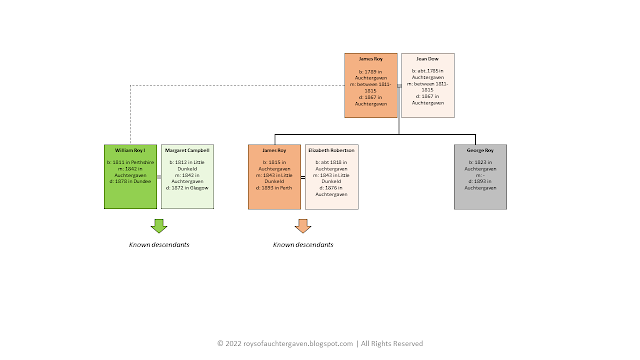
Confused about where these characters fit into the family tree? Or where this action is occurring?  You can always check The Family Tree and Map pages for visual clues.


Footnotes
  1. Census record for William Roy, aged 30, Colly, Auchtergaven, Scotland, 1841 Scotland Census, National Records of Scotland, scotlandspeople.gov.uk.; Census record for Margaret Campbell, aged 25, Meikle Logie, Little Dunkeld Scotland, 1841 Scotland Census, National Records of Scotland, scotlandspeople.gov.uk.
  2. Marriage of William Roy and Margaret Campbell, married 4 March 1842, Old Parish Registers Marriages, 330/20 p.339.
  3. Alison Mitchell (ed) Monumental Inscriptions (pre 1855) in North Perthshire, Vol. 2, p.211.
  4. Baptism of James Roy, born 4 December 1842, Old Parish Registers Births, 330/20 p.212..
  5. Baptism of John Roy, born 26 February 1844, Old Parish Registers Births, 330/20 p.221; Baptism of William Roy, born 8 April 1846, Old Parish Registers Births, 330/20 p.221; Baptism of Susan Roy, born 22 April 1848, Old Parish Registers Births, 330/20 p.237; Baptism of George Roy, born 8 December 1849, Old Parish Registers Births, 330/20 p.270.; Baptism of Donald Roy, born 5 August 1853, Old Parish Registers Births, 330/20 p.270.
  6. West Stormont Historical Society, Auchtergaven Graveyard Inscriptions, Entry No.311.
  7. Auchtergaven kirk session, Minutes (1808-1855) and Proclamations (1855-1861), CH2/22/2, image 00310.
  8. Macphail's Edinburgh ecclesiastical journal and literary review, Vol. XIX, Myles Macphail, Edinburgh, 1855, p.384
  9. The Globe (London), 12 April 1856, p.1.
  10. Perth and Kinross Council Archive; Cess Rolls Perthshire, 1848-1848; Roll: SCPERa018_029Cs18481848, 1848.

Tuesday, 29 March 2022

Margaret Campbell - the first 30 years


In the previous post, we looked at William Roy I's first 30 years, now it's time to turn to Margaret Campbell. One of the frustrations of 19th century family history research is that the women feature in any records a lot less than the men, and piecing together their lives is often even more of a jigsaw puzzle. However, by looking at the records that exist for all of the immediate family it's often possible to create a fuller picture of the lives of the women. 

Margaret Campbell was born 25 March 1812 in Meikle Logie* to John Campbell and his wife, Susan Cameron. The record of her baptism says:

Campbell, Margaret. Dr to  John Campbell and Susan Cameron in Mickle Logie was born 25 March and baptized 29 - 1812 - 1

John Campbell and Susan Cameron had married three years earlier in 1809. However, their marriage was not without some controversy, as the parish register states:

1809, Dec 6 - John Campbell in Mickle Logie and Susan Cameron, Little Trochrie were married this day after paying a fine for want of being proclaimed.2

'Proclamation' was the process by which intention to marry was publicised to the congregation of the parish. Generally the banns (the notice of the proposed marriage) were proclaimed on three successive Sundays, which gave the community an opportunity to object if there was a reason why the couple shouldn't marry. A fee was paid to the kirk for the proclamation readings.3 

For a couple to leapfrog this process, and pay a fine in lieu would usually be an indication that they were in a hurry to get hitched - which indeed, John Campbell and Susan Cameron appear to have been...as the Little Dunkeld parish register of births shows that their first son, James Campbell was born just over six months later on 10 May 1810.4 

Whereas for William Roy I's birth we were able to follow the saga through the Auchtergaven Kirk Sessions, unfortunately no kirk session records survive for the parish of Little Dunkeld. We'll just have to imagine that John and Susan were rebuked and absolved for what appears to be a case of 'ante-nuptial fornication'. 

Margaret's birth came less than two years after James' and was followed by three more siblings. Altogether, the family consisted of:

Children of John Campbell and Susan Cameron (married 1809)

  • James Campbell, son born 10 May 1810 5
  • Margaret Campbell, daughter born 25 March 1812 6
  • John Campbell, son born 30 July 1814 7
  • Donald Campbell, son born 24 June 1816 8
  • Euphan Campbell, daughter born 6 June 1820 9

Later on, in the 1841 Census, we'll see that Susan Campbell, Donald and Margaret are still at Meikle Logie, so it is likely that the family grew up there between 1809 and 1841. 

Meikle Logie was a small rural hamlet in the Strathbran district, about 3.5 miles (5.5 km) from the more populous centre of Little Dunkeld. It has a sheltered hillside setting and overlooks the Birnam and Trochry Hills to the south. (It's also a short distance from Ballinloan, where William Roy I possibly spent the initial five or so years of his life).

Farmland in Strath Braan - looking across to Meikle Logie (2008)
cc-by-sa/2.0 - © Richard Webb - geograph.org.uk/p/1025927

Access road to Meikle Logie (2014)
cc-by-sa/2.0 - © Stanley Howe - geograph.org.uk/p/4002296

According to the reported occupation on Margaret's death certificate in 1872, her father John Campbell was a farmer.10 This seems to be accurate, as in the 1851 Census, the widowed Susan Campbell, aged 67, is shown as being a farmer of 2 acres in her own right.11 They would have lived at Meikle Logie with the families of other farmers, agricultural labourers and linen hand loom weavers. 

Most Sundays, the family would have had to walk the 3.5 miles into Little Dunkeld to attend the parish church there, but once a month, they would have taken a very short walk  (less than 0.3 mile/ 500 metres) down their track, and along the narrow road towards Little Dunkeld to the nearby church of Laganallachy*.  This was a local church which was maintained by subscriptions and services by the people of the district. The Minister from Little Dunkeld conducted services there every fourth Sunday.  Of particular note is the fact that these services were conducted wholly in Gaelic.12

The 1845 Statistical Account confirms that Gaelic was widely spoken in the Strathbran district:

Languaqe.-The language generally spoken in the two most populous districts, viz. Strathbran and the Bishoprick, is the Gaelic, which does not seem to be losing ground, though the English is more generally understood than formerly. About four-fifths of the inhabitants are a Gaelic population, and much attached to their vernacular tongue.13 

Little Dunkeld was one of only a small number of parishes in Perthshire that maintained Gaelic language into the 19th Century.14 

It is not clear at what point services ceased at Laganallachy, but by 1838, the church was described as being 'in bad repair and uncomfortable in winter'.15

The following streetview from Google Maps shows what remains of Laganallachy Church today. 

The inscription of a stone in the graveyard we can see above tells us that Margaret's father, John Campbell died at Meikle Logie on 18 March, 1839, aged 59. The stone was erected by Margaret's brother, Donald in memory of their father, and also memorialises another brother, John who died in Bankfoot (8 May 1853, aged 37), and Donald himself (died 30 April 1895) as well as Donald's wife, Cecilia Cath Pullar (died 10 October 1899 aged 68) and their son, John Pullar Campbell (died in Motherwell, 1878 aged 19).16

So, when we look at the 1841 Census (the year before Margaret married William Roy), we find 25 year old Margaret living in a household at Meikle Logie with her 55 year old mother (keep in mind the ages were often rounded in the 1841 census) and her 20 year old brother, Donald, who is listed as the head of the household. His occupation is shown as 'tailor' and this was still his occupation on his death certificate in 1895.17

Image reproduced with the permission of the National Library of Scotland

Nowadays, Meikle Logie consists of what appears to be just four homes, but in 1841 it was a bustling hamlet, with 14 separate households consisting of a total of 61 people listed in the 1841 Census. Of these entries, five heads of households had the surname 'Campbell', but my research so far would suggest they are cousins of Margaret and Donald, rather than their siblings (who I am still to track down). The 1867 Ordnance Survey Map snippet above shows the outlines of the many buildings at Meikle Logie, the well on the edge of the woods, and the proximity of Meikle Logie to nearby Laganallachy Church.18 

(An interesting aside - some of the old farmsteading buildings at Meikle Logie have been transformed into a very comfortable home by Edinburgh architects, Robert Bruce Design - click on the link to see what they did - and for some more photos of Meikle Logie and surrounds, have a look at the Meikle Logie Farmhouse Cottage which is listed as a holiday let on AirBnB.)

On the census night of 6 June 1841, at an actual 29 years of age, we find Margaret living with her widowed mother and youngest brother at Meikle Logie.  Nine months later, she marries William Roy, and is described in the parish register as 'residing at Bankfoot',19 which would suggest she had moved there - perhaps to work, or to live with her brother John (who died at Bankfoot in 1853, according to the inscription on the gravestone).  

So that brings us up to date with approximately the first 30 years of both William and Margaret's lives. Next up...their marriage and family life in Bankfoot. 

Confused about where these characters fit into the family tree? Or where this action is occurring?  You can always check The Family Tree and Map pages for visual clues.

* There are multiple spellings of Meikle Logie and Laganallachy in the records - i.e. Mickle Logie, Mickeloggie, Lagganallachie... For simplicity, I have chosen to stick with Meikle Logie and Laganallachy. 

Notes

  1. Baptism of Margaret Campbell, born 29 March 1812, Old Parish Registers Births, 373/ 10 Little Dunkeld, p.316.
  2. Marriage of John Campbell and Susan Cameron, married 6 December 1812, Old Parish Registers Marriages, 373/10, p.413.
  3. Old Parish Registers – Marriages and Proclamation of Banns', National Record of Scotland, https://www.nrscotland.gov.uk/research/guides/birth-death-and-marriage-records/old-parish-registers/marriages-and-proclamation-of-banns, accessed 29 March 2022.
  4. Baptism of James Campbell, born 10 May 1809, Old Parish Registers Births, 373/ 10 Little Dunkeld, p.301.
  5. Baptism of James Campbell.
  6. Baptism of Margaret Campbell.
  7. Baptism of John Campbell, born 30 July 1814, Old Parish Registers Births, 373/10, p.331.
  8. Baptism of Donald Campbell, born 30 June 1816, Old Parish Registers Births, 373/10, p.341.
  9. Baptism of Euphan Campbell, born 6 June 1820, Old Parish Registers Births, 373/10, p.408.
  10. Death registration of Margaret Campbell, died 13 July 1872, Glasgow, National Records of Scotland, scotlandspeople.gov.uk.
  11. Census record for Susan Campbell, aged 67, Mickellogge, Little Dunkeld, 1851 Scotland Census, National Records of Scotland, scotlandspeople.gov.uk.
  12. W. & A.K. Johnston, Report of the Commissioners of Religious Instruction, Scotland, Commissioners of Religious Instruction (Scotland), 1838.
  13. J Gordon (ed), The New Statistical Account of Scotland / by the ministers of the respective parishes, under the superintendence of a committee of the Society for the Benefit of the Sons and Daughters of the Clergy, Little Dunkeld, Perth, Vol. 10, Edinburgh: Blackwoods and Sons, 1845, p. 1010. University of Edinburgh, University of Glasgow. (1999) The Statistical Accounts of Scotland online service: https://stataccscot.edina.ac.uk:443/link/nsa-vol10-p1010-parish-perth-little_dunkeld.
  14. Charles W. J. Withers. ‘A Geography of Language: Gaelic-Speaking in Perthshire, 1698-1879’, Transactions of the Institute of British Geographers 8, no. 2 (1983): 125–42. https://doi.org/10.2307/622107.
  15. W. & A.K. Johnston, Report of the Commissioners of Religious Instruction, Scotland.
  16. Alison Mitchell (ed) Monumental Inscriptions (pre 1855) in North Perthshire, Vol. 2, p.211.
  17. Census record for Susan Campbell, aged 55, Meikle Logie, Little Dunkeld Scotland, 1841 Scotland Census, National Records of Scotland, scotlandspeople.gov.uk.
  18. Ordnance Survey Map, Six-inch 1st edition, 1843-1882, Perthshire, Sheet LXI, Survey date: 1863-4,  Publication date: 1867, National Library of Scotland, https://maps.nls.uk/.
  19. Marriage of William Roy and Margaret Campbell, married 4 March 1842, Old Parish Registers Marriages, 330/20 Auchtergaven, p.339.


Tuesday, 8 March 2022

William Roy I - the first thirty years


So, we've established that William Roy I was born sometime between 24 March 1811 and 12 May 1811 (the dates when a. his grandmother appeared on his pregnant mother's behalf before the Auchtergaven Kirk Sessions and b. when his baptism is recorded in the Auchtergaven Parish Church register). But what happened after that?

Unfortunately, records of the period between 1811 and 1841 (the first Scottish census that is indexed and available online) are relatively scant, so we need to piece together the timeline from fragments of information.

Given that William's mother, Ann Peddie was living in the parish of Little Dunkeld at the time she was called to appear before the Kirk Session, it is possible that she had returned to her parents' home at Ballinloan.1 

Ballinloan farm in 2010 cc-by-sa/2.0 - © Russel Wills - geograph.org.uk/p/1543620

We don't know how long she would have remained there. Earning an income to support herself and her child would possibly have been a priority, and she may even have left William with his grandparents while she sought servant work elsewhere. 

Nearby, Margaret Campbell, William's future wife, grew up in Meikle Logie which is less than a mile (1.5 kms) from Ballinloan, and the Campbell and Peddie families attended the same small church of Laganallachy, so perhaps William met Margaret first while living at Ballinloan and they may even have been childhood friends?2

What we do know for sure is that William's mother, Ann married John Cowans on 6 January 1817 in Little Dunkeld.3 However, while the record states that she is from Little Dunkeld, he is of the 'Parish of Auchtergaven'. William would have been about six years old at that time. 

Almost exactly one year later, in January 1818, the first child of that marriage was born - Peter Cowans. A second son, William followed in July 1819 and a third, David in December of 1823 . In each of these cases, the Auchtergaven parish register shows that the family was living at the Tullybelton Loch.4 

The Loch of Tullybelton is a small inland loch about two miles in a straight line (3.25 kms) from the Glack, where William's father, James lived at the time of William's birth.  James was no longer living there though. By 1815, he was living in the village of Bankfoot with his wife, Jane Dow and their baby son, James -  and a second son, George was also born in Bankfoot in 1823.5

Loch Tullybelton cc-by-sa/2.0 - © Richard Webb - geograph.org.uk/p/4794167

There's then a gap of almost 20 years in the records, before we can pick up the trail again with the 1841 Scotland Census. At this point in time, we find Ann and John Cowans at Corral Quarry near Bankfoot. 

A description of 'Corral Quarry' can be found in the Ordnance Survey Name Books for Perthshire:
This name applies to a Quarry and a Cothouse, the former is disused, the latter is one storey in height, slated and in good repair, and takes its name from the quarry. Property of Thomas Wylie Esqr. Airleywight.6
John is 70 and Ann is 60 (keeping in mind that ages in the 1841 census were rounded down to the nearest 5 years) and John's occupation is shown as 'flesher' (i.e butcher). None of the sons are living with them.7

James and Jane/Jean Roy are still living in the village of Bankfoot, where their ages are shown as 45 and 50 respectively. Their two sons, James and George  (aged 20 and 15) live with them, together with Thomas McLeish, a 45 year old farm servant. James and both sons are shown as being 'Linen H.L.W' (hand loom weavers), three of the many workers supporting the burgeoning linen industry in Auchtergaven.8 

By 1841, William Roy I was, of course, now 30 years old, so I had to look further afield for him. But he hadn't gone too far.  I found him in a household at 'Colly', which refers to Balmacolly (or the Mill of Balmacollie), a place still within the Auchtergaven Parish. Once again, a description can be found in the Ordnance Survey Name Books:
Consists of a Corn Mill and Farmsteading. the buildings are partly one and partly two storeys in height all slated and in good repair, property of His Grace the Duke of Atholl.9
William is the head of his household and his age is recorded accurately as 30 years old. His occupation is given as 'miller' and he is the only miller at Balmacolly.  Also living in the same household are:
  • Christian Marshall, 19 year old F.S (female servant)
  • John McFarlane, 30 year old Ag. Lab (agricultural labourer)
  • John Robertson, 29 year old Ag. Lab
  • Donald Duff, 17 year old Ag. Lab
  • James Pryor, 19 year old, Ag. Lab
The farmer at Balmacolly at that time (shown on the same page in a separate household with his family) was Peter McFarlane.10 

(Interesting aside...Balmacolly is still a working farm today, and if you visit the Bankfoot Inn, all the beef on their menu is from Balmacolly Farm)

Anyway, to get back to William... At 30 years of age, he is a miller at the Balmacolly Corn Mill. On the following ordinance survey map (dating from 1864) you can see that the corn mill was located alongside the Wharry Burn which would have provided the water to power the mill.11 
 
Image reproduced with the permission of the National Library of Scotland.

Mills such as these were used to make oat and barley meal commercially, and the 'miller' who was in charge of the mill, held a highly-regarded role in the community. To acquire the skills of being a miller, it is likely that William had been an apprentice to one first. A miller's skills, 'seemed always to be in demand in preindustrial times'.12 The advent of steam and rapid industrialisation of agriculture however, eventually changed the milling industry. 

So, on the census night of 6 June 1841, at 30 years of age, we see that William has acquired a highly-regarded skill, and is gainfully employed. Nine months later, he marries Margaret Campbell.13 But that, and what happens next, are stories for a future post...


Confused about where these characters fit into the family tree? Or where this action is occurring?  You can always check The Family Tree and Map pages for visual clues.


Footnotes
1. Auchtergaven kirk session, Minutes (1808-1855) and Proclamations (1855-1861), Session 15th, 24 March 1811, National Records of Scotland, CH2/22/2, Image 00007; Baptism of Anna Peddie, born 7 January 1780, Old Parish Registers 373/ 10  Little Dunkeld, p.139.
2. Baptism of Margaret Campbell, born 29 March 1812, Old Parish Registers Births, 373/ 10 Little Dunkeld, p.316; Alison Mitchell (ed), North Perthshire Monumental Inscriptions, Vol.2, p.211.
3. Marriage of Anne Peddie and John Cowans, married 6 January 1817, Old Parish Registers Marriages, 373/10 Little Dunkeld, p.435.
4. Baptism of Peter Cowans, born 7 January 1818, Old Parish Registers Births, 330/10 Auchtergaven, p.212; Baptism of William Cowans, born 17 July 1819, Old Parish Registers Births, 330/10 Auchtergaven, p.222; Baptism of David Cowans, born 6 December 1823, Old Parish Registers Births, 330/20 Auchtergaven, p.35.
5. Baptism of James Roy, born 17 February 1815, Old Parish Registers Births, 330/10 Auchtergaven, p.199; Baptism of George Roy, born August 1823, Old Parish Registers Births, 330/20 Auchtergaven, p.29
6. Ordnance Survey Name Books Perthshire, 1859-1862, Perthshire volume 08, OS1/25/8/38. 
7. Census record for Anne Cowans, aged 60, Corral Quarry, Auchtergaven, Scotland, 1841 Scotland Census, National Records of Scotland, scotlandspeople.gov.uk.
8. Census record for James Roy, aged 45, Bankfoot, Auchtergaven, Scotland, 1841 Scotland Census, National Records of Scotland, scotlandspeople.gov.uk.
9. Ordnance Survey Name Books Perthshire, 1859-1862, Perthshire volume 08, OS1/25/8/53. 
10. Census record for William Roy, aged 30, Colly, Auchtergaven, Scotland, 1841 Scotland Census, National Records of Scotland, scotlandspeople.gov.uk.
11. Ordinance Survey Map, Perthshire, Sheet LXXIII, Survey date: 1864,  Publication date: 1867, National Library of Scotland. 
12. Robert Glen, 'Reviewed Work: The Scottish Country Miller 1700-1900: A History of Water-Powered Meal Milling in Scotland by Enid Gauldie', Technology and Culture, Vol. 25, No. 2 (Apr., 1984), p. 336.
13. Marriage of William Roy and Margaret Campbell, married 4 March 1842, Old Parish Registers Marriages, 330/20 Auchtergaven, p.339.

Tuesday, 22 February 2022

Did James Roy and Anne Peddie marry?


Throughout my research across the broader family tree, I have found many occasions when the first child of a family (sometimes more than just the first child) is born before the parents marry. I have also found cases where the parents do not marry, and/or go on to marry other people. Therefore, I was interested to follow James Roy and Anne Peddie over the years subsequent to William I's birth to see what happened with them.

So, did they marry? The short answer is, no. Not to each other. 

Without any concrete evidence, I can only make guesses as to what their circumstances were. One of the possible scenarios is that James, a 21 year old farm labourer, did not have the economic capability to marry at that time - which would have required him to set up his own household. Maybe his own family didn't approve of Anne, or they didn't have the ability to support another family in their own household? Perhaps there was never an intention of a permanent relationship, and William was the result of a one-off encounter? Maybe James and Anne just didn't like each other enough to marry? Perhaps James was already committed to someone else? We will never know the details of their situation.

James' family were farmers at Glack, which was a small hamlet a few miles from what became the village of Bankfoot. The map below, from a slightly later era (1850s -1860s) shows the outlines of the buildings at Glack and nearby Balquharn and Gibbeston.1  Anne was nine years older than James, and had been working as a servant to John Fisher at Glack for 'a few years'.2  

Image reproduced with the permission of the National Library of Scotland.

By the time she was called to the Kirk Session, Anne had left Glack and was living in Little Dunkeld. The most likely explanation is that she went back to her own family as she awaited the birth of her child. If that is the case, she would have been living at Ballinloan - another small hamlet, which is about 4.5 miles (7.25 km) in a straight line from Glack (see image below), but is separated by a range of hills.

Image reproduced with the permission of the National Library of Scotland.

In most cases at that time, illegitimate children were raised by their mothers or the mother's family, so it is likely that Anne cared for William Roy I in Little Dunkeld for the first few years of his life, perhaps in the home of her parents and/or siblings. Indeed, Margaret Campbell, William's future wife, grew up in Meikle Logie which is less than a mile (1.5 kms) from Ballinloan, and the Campbell and Peddie families attended the same small church of Laganallachy, so perhaps William and Margaret were childhood friends.3 

We next see James Roy and Anne Peddie in the Old Parish Registers of  Auchtergaven and Little Dunkeld respectively. 

On February 17, 1815 in Auchtergaven:

James Roy of Bankfoot had a son by his wife, Jane Dow, born this day and baptized - named - James.4 

Although I cannot find a marriage register entry for James and Jane, we can surmise from the words 'his wife' that they had already married - nothing got past those parish clerks, they wouldn't have written wife unless she officially was. 

And in Little Dunkeld, when William Roy I was almost six years old, Anne married John Cowan:

January 6th 1817, John Cowan, Parish of Auchtergaven and Anne Peddie in this, one sabbath and no objections. 5

By following up both pairings through first the old parish records, and then the statutory registers, I have been able to establish that between the two marriages, William Roy I ended up having five half-brothers. (Note - spellings and versions of names vary between records (e.g. Anna/Ann/Anne, Cowan/Cowans and Jean/Jane).

Children of John Cowan(s) and Ann(e) Peddie (click to make larger)


Children of James Roy and Jean/Jane Dow (click to make larger)


There's still a lot of work to be done in following each of these branches, but my initial thoughts are that:
  • William Cowans and Ann Fenwick ended up in Glasgow, very near to where William Roy II lived.6
  • Is it possible that Peter Cowans married Grace Stewart and emigrated to Ontario in Canada where he was a farmer with multiple children and died there in 1881.7
  • George Roy never married and died a pauper at Waterloo in Auchtergaven in 1893.8
  • In the same year, George's brother James died in Perth. He had married Elisabeth Robertson and they had seven children, but four of them died between the ages of 9 and 22. The three others have not yet been traced.9
When William Roy I's father, James and stepmother, Jane both died in 1867, it was William who was the informant on both their death registrations - listed as 'son' and 'son-in-law' respectively, indicating that William had been close to his biological father and wife.10  I have not found details of John and Ann Cowans' deaths, but they are likely to have died between 1841 and 1851, as they appear in the 1841 census in Auchtergaven, but not in the 1851 anywhere in Scotland.

So, with the addition of these half-brothers to William Roy's family, the branches widen and it potentially adds relatives in Canada from the middle of the 19th century onwards. More to follow up in future posts!

Confused about where these characters fit into the family tree? Or where this action is occurring?  You can always check The Family Tree and Map pages for visual clues.


Footnotes
1. Ordnance Survey, One-inch to the mile maps of Scotland, 1st Edition - 1856-1891, Sheets 47 & 48, National Library of Scotland
2. Auchtergaven kirk session, Minutes (1808-1855) and Proclamations (1855-1861), Session 15th, 24 March 1811, National Records of Scotland, CH2/22/2, Images 00007 and 00009.
3. Baptism of Margaret Campbell, born 29 March, Old Parish Registers Births 373/ 10 Little Dunkeld, p.316; Alison Mitchell (ed), North Perthshire Monumental Inscriptions, Vol.2, p.211.
4. Baptism of James Roy, born 17 February 1815, Old Parish Registers Births 330/10 Auchtergaven, p.199.
5. Marriage register entry of John Cowan and Anne Peddie, married 6 January 1817, Old Parish Registers Marriages 373/10 Little Dunkeld, p. 435.
6. Census record for William Cowans, aged 56, 177 Main Street, Barony, Glasgow, Scotland, 1881 Scotland Census, National Records of Scotland, scotlandspeople.gov.uk.
7.  This individual on the familysearch.org tree appears to match the details of Peter - however further research is required to substantiate this: https://www.familysearch.org/tree/person/details/GM5B-PVV, accessed 22 February 2022.
8. Death registration of George Roy, died 11 June 1893 in Auchtergaven, Perthshire, National Records of Scotland, scotlandspeople.gov.uk.
9. Death registration of James Roy, died 25 September 1893 in Perth, Perthshire, National Records of Scotland, scotlandspeople.gov.uk; Auchtergaven Graveyard Inscriptions, West Stormont Historical Society, 2008, entry no.105, https://bankfootchurchdotorg.files.wordpress.com/2018/01/auchtergaven-memorial-inscriptions.pdf, accessed 22 February 2022. 
10. Death registration of Jane Roy, died 11 January 1867 in Auchtergaven, Perthshire, National Records of Scotland, scotlandspeople.gov.uk; Death registration of James Roy, died 30 April 1867 in Auchtergaven, Perthshire, National Records of Scotland, scotlandspeople.gov.uk.

Saturday, 12 February 2022

Kirk session discipline


We know that both James Roy and Ann Peddie (and Ann's mother) appeared before the Auchtergaven Kirk Session in relation to their charge of fornication, but what were the implications of this for them? 

In both James and Ann's case, the kirk session record says that they were 'suitably rebuked by the Minister' and then 'absolved from the scandal of it'. There is no mention of any public rebuking, so I suspect that the rebuke (i.e. telling off or reprimand) was just done in the session house by the Minister and then announced publicly afterwards from the pulpit.  

This wasn't always the case, however. In earlier days, public rebuke was often the standard, with offenders having to appear before the congregation to confess, or being made to sit on 'the repentance stool' or 'the pillar' - the names given to the place within or outside the church where guilty parties had to stand or sit during a Sunday service (often three times for a first offence) to be publicly shamed before the congregation.1 

Even earlier, traditions such as the wearing of sackcloth, shaving of heads and  'jougs' were often used - 'jougs' was an iron ring or collar 'fastened to a church door, a tree in a churchyard, the post of a church gate, a market cross, or a market tron, or weighing post' and fastened around the neck of the culprit, designed to publicly shame the offender. 2

But it seems like James and Ann were absolved with just a private rebuke. 

However, that wasn't the end of the story. A check of the Auchtergaven Parish Accounts for 1811 shows that on May 12, 1811, a fine of 10 shillings was collected from 'a person guilty of fornication'.3

Auchtergaven kirk session, Accounts (1790-1827), CH2/22/4, Image No. 72.

This is the same day that James appeared before the kirk sessions, so it is likely that this fine was imposed on him. There is no similar entry on the day that Ann appeared, so I'm assuming that only James was fined. 

Looking back through previous years' accounts for the parish, 10 shillings was about an average amount to be fined for fornication. In 1805, there were instances of offenders being fined 1 pound each. The charge of ante-nuptial fornication (i.e. the offenders were found out after their marriage because their child was born within nine months4) seemed to attract a lesser fine. Some of those instances I found ranged from 2 to 5 shillings. 

Fines like these could be considered a form of tax - as the money went straight into the kirk funds which were then used to support the poor of the parish - often single mothers with illegitimate children. To put James' 10 shillings fine amount into perspective,  the collection from the entire congregation that  Sunday was only just over 11 shillings and on the payments page of the accounts, payments were made to the poor during May of between 3 to 8 shillings each. Indeed, the 1798 Statistical Account of Auchtergaven reported that, 'there are generally 6 or 8 paupers upon the list, who receive from 5s. to 10 s. per month, according to their necessities.  So the fine paid by James was sufficient to support one pauper for a month.5

What happened with James and Ann next? Did they eventually marry? Where was William Roy I raised, and who supported him? More questions to be explored in future posts! 

Confused about where these characters fit into the family tree? Or where this action is occurring?  You can always check The Family Tree and Map pages for visual clues.


Footnotes

1. Andrew Edgar, Old Church Life in Scotland: Lectures on Kirk-session and Presbytery Records, Alexander Gardener, Paisley & London, 1885, p.285.

2. William Andrews, Bygone Punishments, William Andrews, London, 1899, p.176,  https://electricscotland.com/history/02BygonePunishmentsScotland.pdf, accessed 12 February 2022. 

3. Auchtergaven kirk session, Accounts (1790-1827), CH2/22/4, Image No. 72.

4. Leah Leneman and Rosalind Mitchison, 'Girls in Trouble: The Social and Geographical Setting of Illegitimacy in Early Modern Scotland', Journal of Social History, Spring, 1988, Vol. 21, No. 3, pp. 483-497

5. Sir John Sinclair, The Statistical Account of Scotland, Auchtergaven, Perth, Vol. 17, Edinburgh: William Creech,  p. 551. University of Edinburgh, University of Glasgow. (1999) The Statistical Accounts of Scotland online service: https://stataccscot.edina.ac.uk:443/link/osa-vol17-p551-parish-perth-auchtergaven, accessed 12 February 2022.


Friday, 28 January 2022

Fornication, rebuke and absolution...tales from the kirk sessions


Remember how I found William Roy I’s baptism in the Auchtergaven parish register? It said:

1811, May 12 - James Roy, Glack, had a child in fornication by Anne Peddie, baptised, named William. 1

To find out more about this, I needed to consult the Auchtergaven kirk sessions. The kirk sessions were the local church courts, comprising the Minister and the elders of a congregation. Their meetings, decisions and records were documented by an elder who was appointed session clerk (often the local school teacher). The kirk sessions also had responsibility for poor relief and education. 

The minute books contain a record of hearings of any disciplinary cases on social and moral offences, and the decisions taken at those hearings, as well as a multitude of other lists or records, varying from parish to parish.2 

One of the roles of the kirk sessions was to uphold exacting moral standards, so they investigated and punished offences of ‘sexual deviance, drunkenness, quarrelling, doctrinal controversy, and breaches of the sabbath’.3 One of the more commonly investigated offences was ‘fornication’ by unmarried couples.4  So, I suspected I would find out more about James and Anne if I could read the kirk sessions. 

However, the records of the kirk sessions could only be viewed in person in the National Records of Scotland’s search rooms in Edinburgh - which was a slight obstacle to a researcher across the other side of the world. 

Until last year…

On 16 March 2021, more than 6,000 Church of Scotland kirk session, presbytery and synod records were made available via the Virtual Volumes system on Scotland’s People. It was a bonanza for locked-down genealogists all over the globe - suddenly we had free access to pages and pages of kirk session records (viewing the pages is free, downloading a page incurs a cost). I wasted no time in exploring the Auchtergaven kirk sessions and what I uncovered was very enlightening.  

Given I knew that William Roy I had been baptised in 1811, I started with Auchtergaven's 1810 kirk session minutes and worked forward. It can be a laborious process as the minutes are not indexed, so I needed to scan every individual page for any mentions of ‘James Roy’ or ‘Anne Peddie’. Plus of course, the entries are all handwritten in the ‘running hand’ script of that era. To assist in my deciphering and understanding of these records, I did a short on-line course from Glasgow University on Early Modern Scottish Paleography via the Futurelearn website (which, by the way, I recommend to anyone starting out with reading Scotland’s old records).

Helpfully, the Auchtergaven session clerk at the time (James Scott - more about him later...) kept fastidious records, with margin notes of the names of the parties.  A couple of pages in, I spotted the first mention of this case in an entry dated 24 March 1811:

Auchtergaven kirk session, Minutes (1808-1855) and Proclamations (1855-1861), Session 15th, 24 March 1811, National Records of Scotland, CH2/22/2, Image 00007.

I’ve transcribed this entry below:

Session House of Auchtergaven March 24, 1811
Session 15th
Case of James Roy & Anne Peddie

Which day the session met after divine service, and was constituted by prayer. The Minister reported that Anne Peddie sometime servant to John Fisher in the Glack of this Parish accused of being with Child, was summoned to appear before the session this day, but in consequence of her not being able to attend Herself, Her mother, who resides in the Parish of Little Dunkeld waited on him and stated that she was directed by Her Daughter the said Anne Peddie to inform Him that She was with Child and that She gave up James Roy in the Glack of this Parish as the Father of Her Child, also that the said James Roy has confessed that He was guilty of fornication with Her. The session closed with prayer.

James Scott, Session Clerk.5

Then, on 12 May 1811 (the same day that William Roy I was baptised), James was called to account in the very next entry on the same page of the kirk sessions:

Session House of Auchtergaven May 12, 1811
Session 16th
Case of James Roy

Which day the session met after divine service, and was constituted by prayer. Compeared the aforesaid James Roy, guilty of fornication with Anne Peddie, and was suitably rebuked by the Minister for his offence. He was then absolved from the scandal of it.  The session closed with prayer.

James Scott, Session Clerk.6

(Note - ‘compeared’ is an old Scots word which means to appear before a court as a party.)7

Finally, on 23 June 1811, Anne had her day in court:

Session House of Auchtergaven, June 23 1811
Session 20th
Case of Anne Peddie

Which day the session met after divine service, and was constituted by prayer. Compeared Anne Peddie of Little Dunkeld residing, formerly a few years in this place, guilty of fornication with James Roy of the Glack in this parish, being suitably rebuked by the Minister for her offence, she was absolved from the scandal of it. The session closed with prayer.

James Scott, Session Clerk.8

As a totally unrelated but interesting aside - the handwriting of the Auchtergaven kirk session minutes changes in 1815. The session clerk who recorded James and Anne's matter, James Scott (who was also the parochial schoolmaster) was himself before the kirk session, confessing that he 'had got his servant maid Ann Stewart with child' and a pro tempore clerk was appointed to record the ensuing and very involved proceedings. He was stripped of his session clerk duties and was temporarily suspended as schoolmaster, before he and Ann Stewart were finally 'rebuked and absolved' in January 1817.9    

So what did I learn from the entries regarding the case of James Roy and Anne Peddie? 

  1. Anne Peddie had been a servant of John Fisher at a place called the Glack, and had been there ‘a few years’
  2. James Roy was also from the Glack
  3. Anne was no longer living at the Glack and was now at Little Dunkeld
  4. Anne's mother was also from Little Dunkeld
  5. William Roy I was born sometime between 24 March and 12 May 1811

Once again, this raised a host more questions for me…for instance, what does rebuking and absolving involve? how would this have affected their lives? what happened next with James and Anne? where or what is ‘the Glack’?

All questions to be explored in future posts here on The Roys of Auchtergaven!

Confused about how these characters fit into the family tree? Or where this action is occurring? You can always check  The Family Tree and Map pages for visual clues. 


Footnotes

1. Parish register entry of baptism of William Roy, 12 May 1811, Auchtergaven, Perthshire, Scotland, National Records of Scotland,  330/10/185.
2. Scotland's People, 'Kirk session records', https://www.scotlandspeople.gov.uk/record-guides/kirk-session-records, accessed 28 January 2022.
3. University of Glasgow, ‘The Kirk Session’, Notes from Early Modern Scottish Paleography course on Futurelearn, https://www.futurelearn.com/info/courses/ems-palaeography/0/steps/30838, accessed 28 January 2022.
4. National Records of Scotland, Tracing your Scottish Ancestors: The Official Guide, 7th edn, Birlinn Ltd, Edinburgh, 2021, p.52.
5. Auchtergaven kirk session, Minutes (1808-1855) and Proclamations (1855-1861), Session 15th, 24 March 1811, National Records of Scotland, CH2/22/2, Image 00007
6. Auchtergaven kirk session, Minutes (1808-1855) and Proclamations (1855-1861), Session 16th, 12 May 1811, National Records of Scotland, CH2/22/2, Image 00007.
7. 'Compear v.', Dictionary of the Scots Language, Scottish Language Dictionaries Ltd, 2004,  https://www.dsl.ac.uk/entry/snd/compear, accessed 28 Jan 2022. 
8. Auchtergaven kirk session, Minutes (1808-1855) and Proclamations (1855-1861), Session 20th, 23 June 1811, National Records of Scotland, CH2/22/2, Image 00009.
9. Auchtergaven kirk session, Minutes (1808-1855) and Proclamations (1855-1861), National Records of Scotland, CH2/22/2, Images 00011-00025.

Thursday, 27 January 2022

Seven generations of William Roy...or is it?


For seven unbroken generations in my family tree William Roy has had a son, also called William Roy. No middle names to differentiate - just William and Roy. Within the family we’ve always referred to them by Roman numeral - so my grandfather was William Roy IV,  my great-grandfather was William Roy III and so on. 

But what if the numbering was wrong? What if William Roy (husband of Margaret Campbell) wasn’t the FIRST William Roy? What if his father had also been called William? Would we need to revise our numbering system? This was one of the first research challenges I pursued, but it wasn't until I was able to access the records via Scotland's People that I could reach a conclusive answer. And given one of the Williams had his numeral tattooed on himself, you could say there was considerable skin in this game. 


The 1990s family tree printout I started my research with had no detail about William (or Margaret) other than their names. For each of the generations between myself and them, I was able to find sufficient evidential details to establish the lineage. The other piece of information I knew was that the family hailed from a place called ‘Bankfoot’ or ‘Auchtergaven’ in Perthshire. 


So, to establish whether there was a William Roy one generation before our ‘first’, I needed to locate William Roy’s death registry entry to find out what his parent’s names were. It took a bit of trial and error and a lot of triangulation with details of descendants, but eventually I found his death in Dundee:

Death of William Roy I 1

1878 Deaths in the District of St. Clement in the Burgh of Dundee
Name: William Roy, Illegitimate Farm Labourer, Widower of Margaret Campbell
When and where died: 1878, July Sixteenth, 3hr 13m AM, 30 Rosebank Street, Dundee
Sex: M
Age: 64 years
Parents: James Roy, Farm Labourer (deceased), Ann Peddie, afterwards Cowan (deceased)
Cause of death: Natural decay (6 months) as certified by Peter Young
Informant: John Roy, son, present
When and where registered: 1878, July 16 at Dundee

In this death register entry, the father’s name is given as James. This is one piece of evidence that William Roy is indeed the first of the unbroken line, however it is reliant on the informant (his son John) providing the correct information. I like to have at least two corroborating pieces of evidence to be certain I can rely on any information.    

So, now to look for William’s birth (which, given it is before 1855, would be recorded in the Old Parochial Registers). The age given on his 1878 death certificate is 64 years - which would mean a birth or baptism around 1814. Again, we’re relying on information given by a son, who may not have known exactly what year his father was born…so I used a wider year range of 1810 to 1820 to search Scotland’s People, which brought up 36 William Roys born in Scotland over that time period, but only one who had parents called James Roy/Anne Peddie, and that one was baptised in 1811 in Auchtergaven.

Baptism of William Roy I in the Auchtergaven Parish Register 2

1811, May 12 - James Roy, Glack, had a child in fornication by Anne Peddie, baptised, named William.

Putting these two pieces of evidence together, we can conclude that our numbering system is safe. William Roy I is indeed the beginning of the unbroken chain. No need to edit the tattoo. 

However, this also raises a whole lot more questions - such as, what was the relationship between James and Anne? Did they marry? How was the charge of  'fornication' dealt with by the kirk?

To investigate this further, my next stop is the Auchtergaven parish kirk sessions...


Confused about how these characters fit into the family tree? Or where this action is occurring? You can always check  The Family Tree and Map pages for visual clues. 


Footnotes

1. Death register entry of William Roy, died 16 July 1878, 30 Rosebank Street, Dundee, Scotland, National Records of Scotland, 282/03 0310, p. 104.
2. Parish register entry of baptism of William Roy, 12 May 1811, Auchtergaven, Perthshire, Scotland, National Records of Scotland,  330/10/185.


In the beginning...there was a dot matrix print-out


At some point after 1994 and prior to 2002, my Dad gave me a two page dot matrix print-out of the ‘Roy’ family tree that he had painstakingly compiled on a computer. At the left hand side of the first page were the names ‘WILLIAM ROY m. Margaret Campbell’, a horizontal line linked them to their son and his wife, ‘WILLIAM ROY (1846-1918) m. Isabella Sutherland (1845-1914), and from there the lines split into William and Isabella’s eight children and subsequent generations. 

At that point in time, seven descending generations were recorded from William and Margaret, (my great-great-great-grandparents) through to the first children of my generation.  It had been compiled the ‘traditional’ way - based on memory, my Dad consulting various family members, and using known records. I kept that print-out in a folder in my filing cabinet.


In 2002, I became aware that genealogical research was rapidly advancing on the Internet, and I started investigating what records were available on-line. I pulled the Roy family tree out of the filing cabinet and used it as a starting point. 

Prior to the Internet, family historians had to laboriously trawl through original parish documents at local record offices to uncover long-forgotten birth, baptism, marriage and death details of earlier generations, or mail off requests to record offices to printed certificates to be received by mail. From 1973 (still pre-Internet times) some genealogists could consult the International Genealogical Index (IGI) on microfiche - which was a project of the Church of Jesus Christ of the Latter Day Saints (LDS) to aid their members trace their ancestors. The original IGI was available to public users in microfiche format in the mid-1980s and contained about 108 million entries which had been complied from original historical documents. By the late 1990s a CD-ROM version was available and there was over 200 million entries. In 1999, the FamilySearch website (the LDS family history website) was created and IGI entries were gradually released online by region…which is the point at which I became aware of this.1

One of the datasets the IGI had at that time was the Old Parochial Records of Scotland (OPR) - which are the records of the established Church of Scotland including registers of births/baptisms, marriages and/or proclamations of banns and (sometimes) deaths or burials. Coverage of each parish varies greatly depending on what original documents have survived, but at the extremes, records date from the late 1500s through to 31 December 1854 (when Scotland’s statutory registration took over).2 

Nowadays, the best place to search and view the OPR is the official Government Scotland’s People website which has the original images available for viewing and download (at a cost), but Scotland’s People didn’t exist in 2002.

So, armed with the original print-out of the Roy family tree and a lot of patience, I explored the search functions of the IGI, and slowly started piecing together further details. It was the start of an addiction. It’s now been almost 20 years since those first experimental searches on the IGI, and genealogy on the Internet has exploded dramatically, with digital access now available to Scottish datasets a lone researcher half a world away could only dream about back in the 'noughties'. 

Over that time I have plugged away at various twigs on the family tree, returning often to the original Roy branch and fleshing out its various characters. It’s the stories of our ancestors that draw me in to family history research. The names, places and dates are the scaffolding, but it’s the detail of their lives that really fascinates me. On this blog I aim to capture some of these ancestral stories to pass on to family members present and future.   


Confused about where these characters fit into the family tree? Or where this action is occurring? You can always check  The Family Tree and Map pages for visual clues. 


Footnotes

1. Familysearch, 'International Genealogical Index', https://www.familysearch.org/wiki/en/International_Genealogical_Index, accessed 27 January 2022.

2. National Records of Scotland, Tracing your Scottish Ancestors: The Official Guide, 7th edn, Birlinn Ltd, Edinburgh, 2021, p.33.


Life on Prieston Road

The previous post traced William and Margaret's marriage and the births of their six children. In this post, we look at where they lived...

Popular Posts